Transcription of a Turkish marriage in France is the formality by which a marriage celebrated before a Turkish civil registrar is entered in the French civil status registers. It applies to any marriage celebrated in Turkey where one of the spouses is a French national.
The procedure differs considerably depending on whether or not the spouses obtained a certificate of capacity to marry before the ceremony. This determines the documents to be provided, the processing time and the risk of in-depth checks.
An important point that is often misstated
It is often said that a marriage that has not been transcribed has no effect in France. That is not accurate.
The French Civil Code provides that a marriage validly celebrated by a foreign authority has civil effects in France for the spouses and children, even without transcription. The spouses are therefore married.
However, transcription is the condition for the marriage to be relied on against third parties. Until it has taken place, the French administration, banks, landlords and third parties in general can treat the spouses as if they were not married. The marriage exists, but it is invisible.
The practical consequences of not transcribing
The legal distinction above is clear, but its practical effects are serious.
- No French family record book is issued.
- A spouse-of-a-French-national visa cannot be applied for, since it requires a French marriage certificate.
- Acquiring French nationality by marriage is impossible, as transcription is a condition of the declaration.
- The spouses’ French civil status records make no mention of the marriage, which creates a permanent discrepancy with the Turkish civil registry.
- Inheritance and estate matters run into the impossibility of proving the status of spouse.
- Any later procedure is blocked, including registering children and, where applicable, registering a Turkish divorce, which requires the marriage to be in the French registers first.
The document that blocks the most files
The “MERNİS Evlenme Bildirimi”
This is the most frequent mistake, and it costs several months.
The consular post does not accept the simple Formula B, the multilingual extract of the marriage certificate. It requires the full copy of the marriage record, the MERNİS Evlenme Bildirimi, issued by the civil registry after the ceremony.
Three requirements apply. The document must be an original, it must be signed and stamped by the civil registrar, and printouts from the e-Devlet portal are not accepted.
The difference lies in the content. Formula B simply records the marriage, whereas the full copy reproduces all the entries in the register, allowing the consulate to check the spouses’ previous marital status.
The certificate of capacity to marry
The French Civil Code requires French nationals wishing to marry before a foreign authority to obtain a certificate of capacity to marry beforehand. This applies even where both spouses are French, and even where the French spouse has dual nationality.
Issuing the certificate involves publishing the banns and, in most cases, an interview of the future spouses by the consular post. It is therefore an upstream check that the marriage plan is genuine.
Marrying without a certificate does not make the marriage void. Omitting this formality does not affect the validity of the marriage celebrated in Turkey. It simply moves the check downstream, to the transcription stage, where it becomes longer and more intrusive.
Case 1: marriage celebrated with the certificate
The procedure is lighter, as the check was carried out before the ceremony.
- The transcription application form, available on the consular post’s website, completed and signed.
- The Turkish marriage record, MERNİS Evlenme Bildirimi, original, signed and stamped.
- A translation of the marriage record by a sworn translator.
- The marriage contract, if any, original or certified copy, with its translation.
- Birth certificates of children of the couple, born before or after the marriage, if the family record book is not produced.
Case 2: marriage celebrated without the certificate
The file is heavier, as the consulate must check after the event what it would have checked beforehand.
Documents for the French spouse
- The application form, completed and signed.
- An original full copy of the birth certificate, less than three months old. For a birth in France, it is obtained from the town hall of birth; for a birth abroad, from the Central Civil Registry Service in Nantes.
- Proof of French nationality, from the full copy of the birth certificate or, failing that, a French nationality certificate, together with a valid national identity card or passport.
- The original Turkish marriage record with its sworn translation.
Documents for the Turkish spouse
- The individual information form, completed.
- The civil registry extract, Nüfus Kayıt Örneği, original, signed and stamped, with a sworn translation. e-Devlet printouts are not accepted.
- The birth certificate, Formula A, a multilingual extract issued by the civil registry, less than six months old.
- The Turkish identity document and proof of address.
Interview and review by the prosecutor
Where the marriage was celebrated without a certificate, transcription is preceded by an interview of the spouses, together or separately, by the consular authority. The interview covers whether consent is genuine and whether the marriage plan is real.
If the consulate still has doubts
It suspends transcription and refers the matter to the public prosecutor in Nantes.
The prosecutor then has six months to decide. They may order further interviews, including by the police or gendarmerie in France where one of the spouses lives there.
If the prosecutor opposes transcription, the spouses can apply to the Nantes judicial court. Appeals go to the Rennes Court of Appeal, and a further appeal to the Court of Cassation remains possible.
This sequence explains the considerable gap between the two scenarios. A compliant file with a certificate is resolved in a few weeks. A file without a certificate, with doubts, can take several years.
Where to file
The complete file is sent to the consular post responsible for the spouses’ place of residence.
| District | Address |
|---|---|
| Ankara | French Embassy, civil registry department, Paris Caddesi No. 70, 06540 Kavaklıdere, Ankara |
| Istanbul | French Consulate General, civil registry department, Taksim Caddesi, 34435 Taksim, Istanbul |
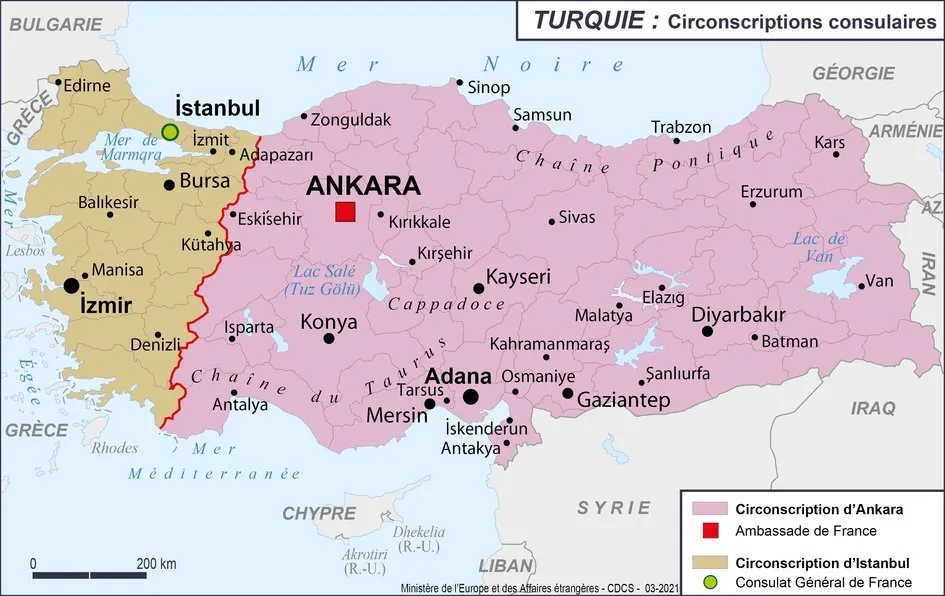
French consular districts in Turkey.
As instructions and forms change regularly, it is prudent to check the list of documents on the post’s website before sending.
Timeframes
| Situation | Average observed duration |
|---|---|
| Marriage celebrated with a certificate of capacity | About two months |
| Marriage celebrated without a certificate | About six months |
| File referred to the Nantes prosecutor | Six additional months, then possible litigation |
These periods run from receipt of a complete file. A missing document does not delay the file by a few days; it pushes back its starting point.
After transcription
The French family record book is sent by post to the address given, and the marriage is noted on the French spouses’ birth certificates. New full copies can then be requested.
Transcription then opens the way to several procedures that depend directly on it.
- The spouse-of-a-French-national visa, then the corresponding residence permit.
- The declaration of French nationality by marriage, subject to conditions on the length of the marriage and shared life.
- Registering the children in the French registers and, correspondingly, in the Turkish civil registry, which follows its own rules set out on our page on Turkish citizenship by descent.
A question rarely asked: what is your matrimonial property regime?
Franco-Turkish spouses often assume they are subject to the French statutory regime. That is not necessarily so.
For marriages celebrated on or after 29 January 2019, the applicable EU regulation in principle designates the law of the spouses’ first common habitual residence after the marriage. For earlier marriages, an international convention uses a similar criterion.
A couple married in Turkey who settle there are therefore generally subject to the Turkish statutory regime, participation in acquired property, in force since 2002. The consequences on separation or death differ significantly from the French regime.
This question is decided case by case, and the applicable law can still be expressly chosen in the required form. It deserves to be examined at the time of the marriage, not twenty years later.
The most frequent mistakes
- Producing a Formula B instead of the full MERNİS copy.
- Sending an e-Devlet printout instead of a signed and stamped original.
- Leaving a spelling discrepancy between the Turkish and French records, which must be corrected at the Nüfus Müdürlüğü before filing.
- Producing an expired French birth certificate, the three-month validity being assessed on receipt.
- Having documents translated by a translator who is not sworn.
- Marrying without a certificate of capacity in the belief that it can easily be regularised afterwards.
- Waiting until a visa or administrative procedure is needed before starting the transcription.
How we help
The firm is based in Turkey and handles the Turkish part of the file. We obtain the full copy of the marriage record and the necessary extracts from the civil registry, arrange sworn translations and, where necessary, start the procedure to correct the Turkish records.
We then prepare the file for the consular post, prepare the spouses for the interview where one is planned, and follow up. If the matter is referred to the Nantes prosecutor or transcription is opposed, we assist our clients in the resulting proceedings.
These steps are part of the services described on our page on civil status and consular procedures in Turkey, and can be carried out under a power of attorney.
The firm advises on civil status and consular procedures in Turkey. For any question about this procedure, you can contact the firm.